Synthetic Data Symposium
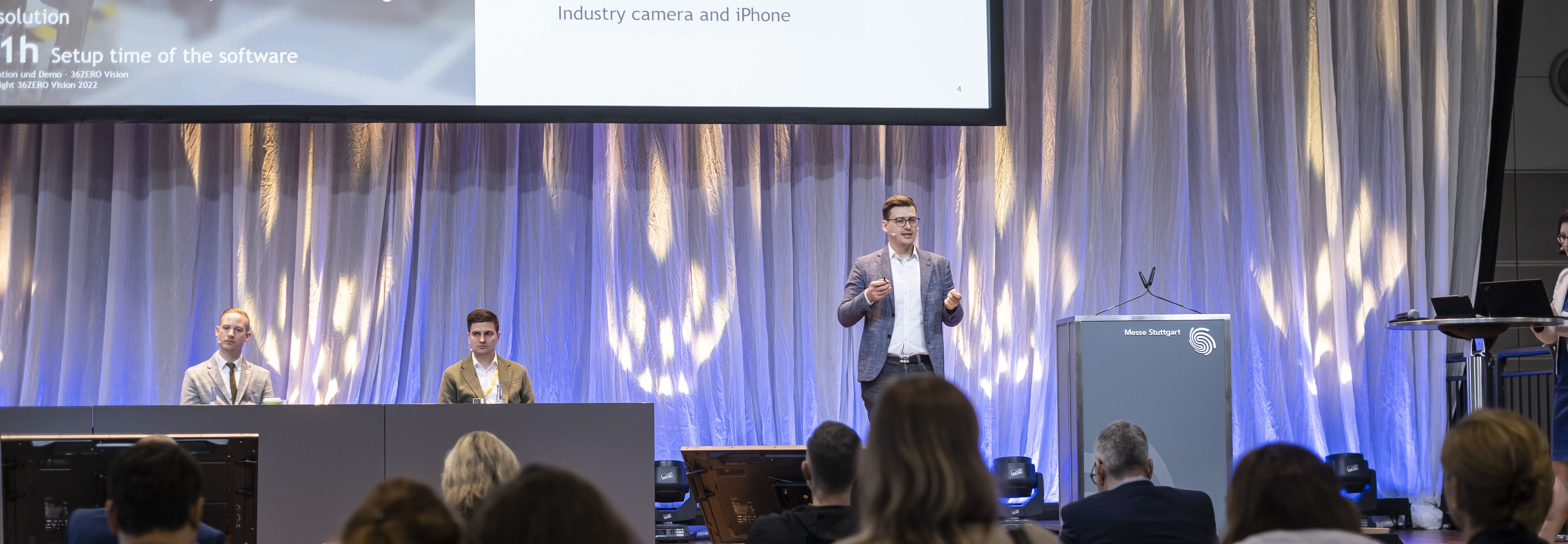
Experience the first Synthetic Data Symposium on 7 and 8 October 2026 in Stuttgart– parallel to VISION, the world's leading trade fair for image processing! Together with Fraunhofer ITWM, we are bringing together leading minds from research and industry to shape the future of AI-based image processing.
Why synthetic data?
The lack of high-quality training data is one of the biggest challenges for artificial intelligence in industrial image processing. Complex annotation processes and unbalanced data sets slow down innovation and automation. Synthetically generated data offers a forward-looking solution here: it enables large amounts of training data to be generated in a targeted and efficient manner, thereby significantly accelerating the development of AI systems.
What you can expect at the symposium
The Synthetic Data Symposium offers you a compact overview of the latest trends, technologies and best practices relating to synthetic data for industrial image processing, manufacturing and quality assurance. Renowned experts from science and industry will share their experiences and provide insights into successful applications – from the simulation of complex production environments to the generation of training data for deep learning.
Join the discussion:
- Which solutions work in practice?
- What are the limitations of synthetic data?
- What does the future hold for AI-supported image processing?

Day 1 | 7 October 2026 | Programm Synthetic Data Symposium
- 09:30 – 09:35 | Symposium opening, Day 1
- 09:35 – 10:00 | Opening speech
- 10:00 – 10:25 | Closing the Synthetic-to-Real Gap with Applied Explainability
- 10:25 – 10:50 | Improving Inspection Performance by Reproducing Micro-Defects in Data-Scarce Environments
- 10:50 –11:15 | Break
- 11:15 – 11:35 | SynthEthik: Ethics-by-Design for Synthetic Anomaly Data in Industrial Quality Control
- 11:35 – 12:00 | 6D Pose Estimation based on Synthetic Data
- 12:00 – 12:25 | Synthetic Data for Optimal Performance of Vision AI
- 12:25 – 12:30 | Symposium: End of Day 1 | Lunch from 12:30
Company/Speaker: tensorleap, Yotam Azriel
Thema:
In this lecture, Tensorleap presents a method for optimizing synthetic data generation by combining applied explainability with synthetic data engines. We furIn this lecture, Tensorleap presents a method for optimizing synthetic data generation by combining applied explainability with synthetic data engines. The method uses an iterative search over generation parameters, evaluating each configuration according to its similarity to real-world data and its effect on model behavior, then refining the search accordingly. This makes it possible to reduce the gap between synthetic and real data not only in terms of human perception, but also in terms of the model’s internal representation of the data. We further show how this approach can be extended to generate samples that target epistemic failure modes, providing a structured way to surface missing knowledge and accelerate model improvement. The method is demonstrated in collaboration with NVIDIA using advanced simulators such as CARLA.ther show how this approach can be extended to generate samples that target epistemic failure modes, providing a structured way to surface missing knowledge and accelerate model improvement.
Company/Speaker: Neurocle, Hongsuk Lee
Thema:
In defect-scarce manufacturing environments, collecting sufficient training data is challenging. Neurocle developed a high-fidelity synthetic defect generation model featuring a patch mode with boundary overlap and smoothing to reproduce realistic micro-defects. Applied to real automotive and battery inspection projects, models trained with synthetic defects achieved over 15% higher accuracy, effectively addressing defect data limitations.
Company/Speaker: University of Augsburg - Center for Future Production (Chair of Moral Theology & Chair of Software Methodologies for Distributed Systems)
Alena Bischoff & Adrian Pfleiderer
Thema:
SynthEthik generates synthetic 2D/3D anomaly data for quality control. We present our technical generation pipeline (from anomaly extraction to fusion) alongside our 'Ethics-by-Design' approach. We showcase how ethical demands act as hard parameters in the AI pipeline to foster trust, prevent de-skilling, and build resilience in Industry 5.0.
Company/Speaker: MVTec Software GmbH, Andreas Zeiler
Thema:
High-quality training data for 6D pose estimation is difficult and expensive to acquire. We showcase "Deep 3D Matching" to prove that real-world data is no longer required for high performance pose estimation. We will demonstrate a 100% synthetic training pipeline that drastically reduces manual engineering effort and costs without compromising on accuracy.
Company/Speaker: DENKweit GmbH, Dr. Dominik Lausch
Thema:
We actually developed our Vision AI from the very beginning (over seven years ago) to work with synthetic data and images in the background. Among other things, this enables our customers to save a huge amount of time. As a result, our AI can be trained using as few as 15 customer images and therefore quickly achieves robust and stable performance. However, thanks to our years of experience and the variety of use cases we’ve encountered, we are also well aware of the limitations and tricky cases.
Day 2 | 8 October 2026 | Programm Synthetic Data Symposium
- 09:30–09:35 | Symposium opening, Day 2
- 09:35 – 10:00 | AI: Not Only a Matter of Data – From Synthetic Generation to Zero-Shot Generalization
- 10:00 – 10:25 | Vision Simulation for Synthetic Data Generation and Virtual Commissioning
- 10:25 – 10:50 | Smarter Vision Projects: Reducing Costs and Boosting Performance with GenAI
- 10:50 –11:10 | Break
- 11:10 –11:35 | Empowering Synthetic Data Content with Virtual System Design
- 11:35 –12:00 | Portable Data Across Cameras and Lighting with Raw-Domain Physics
- 12:00 –12:25 | Surface Inspection using Synthetic Data: The Next Generation
- 12.25 –12.30 | Symposium: Day 2 closing session | Lunch from 12.30
Company/Speaker: Awentia Vision Technologies, Federico Frontali
Thema:
The machine vision industry is currently trapped in a data bottleneck. While synthetic data aims to solve the shortage of labeled images, it only treats the symptom. If a human operator can spot a novel defect without seeing thousands of examples first, the real issue isn't a lack of data—it's the algorithm's inability to generalize. At Awentia Vision Technologies, we believe the future of industrial automation is data-free. Instead of simulating data to feed rigid systems, we must deploy models capable of zero-shot learning. AVT Physical AI allows you to instruct a machine exactly like a human: describe the task with a prompt, and it's ready to work. In this session, we will demonstrate how shifting to a prompt-based, Edge-native architecture eliminates the need for massive datasets. We will show how this paradigm handles high-variability lines, slashes expensive NRE costs, and delivers instant time-to-value without any dedicated training or data generation.
Company/Speaker: Basler AG, Justus Basler
Thema:
Basler presents how vision simulation and synthetic image data accelerate AI-based machine vision development while addressing the Sim-to-Real Gap. Sensor-realistic simulation of cameras, optics, and lighting enables generation of high-quality training data without physical prototypes. Industrial use cases illustrate how simulation supports robust model development and enable faster deployment of machine vision systems.
Company/Speaker: Artificial Pixels GmbH, Dr. Sven Wanner
Thema:
While Generative AI has already fundamentally transformed the creative industries, its potential to revolutionize Computer Vision often remains untapped. This session explores how modern, AI-driven workflows can drastically reduce project timelines and costs. We will discuss strategies to streamline the training process, ensuring that faster development cycles lead to more robust and, consequently, more reliable Vision models.
Company/Speaker: Medabsy GmbH, Dr. Petra Gospodnetic
Thema:
Synthetic data has the capacity to enable machine vision developers to overcome limitations related to data scarcity and cost. However, generating meaningful synthetic data requires more than randomization—it demands a integration of product, defect and imaging component understanding into simulation environment. By using virtual systSynthetic data has the capacity to enable machine vision developers to overcome limitations related to data scarcity and cost. However, generating meaningful synthetic data requires more than randomization—it demands a integration of product, defect and imaging component understanding into simulation environment. By using virtual system design - combining inspection planning with physics-based modeling and configurable virtual environments, it is possible to create physically accurate and context-aware synthetic datasets. These datasets follow real-world industrial scenarios and avoid core issues when using generative models - hallucinations and incapacity to generate out-of-distribution data. This way, users can design inspection strategies, simulate edge case scenarios, and generate labeled data that reflects true system behavior.em design - combining inspection planning with physics-based modeling and configurable virtual environments, it is possible to create physically accurate and context-aware synthetic datasets. These datasets follow real-world industrial scenarios and avoid core issues when using generative models - hallucinations and incapacity to generate out-of-distribution data. This way, users can design inspection strategies, simulate edge case scenarios, and generate labeled data that reflects true system behavior.
Company/Speaker: Dotphoton AG, Bruno Sanguinetti
Thema:
We show how physically grounded raw-domain models make vision data portable across cameras and lighting. Starting from real raw images, we transform sensor response, dynamic range, noise, illumination, and object scale while preserving annotation fidelity. The result is cheaper labeling, faster sensor migration, and more robust training data for deployment.
Company/Speaker: Fraunhofer ITWM, Juraj Fulir
Thema:
Synthetic data for industrial inspection shows it can satisfy the AI data hunger, by providing missing data through domain knowledge and careful modeling of the virtual environment. It produces realistic labeled defect examples across any surface to enhance AI development. Recently, it is being used to design inspection systems. But can we automate the design of inspection systems? Let’s find out!