Aqarios Luna: How Quantum Computing Reaches Real-World Application
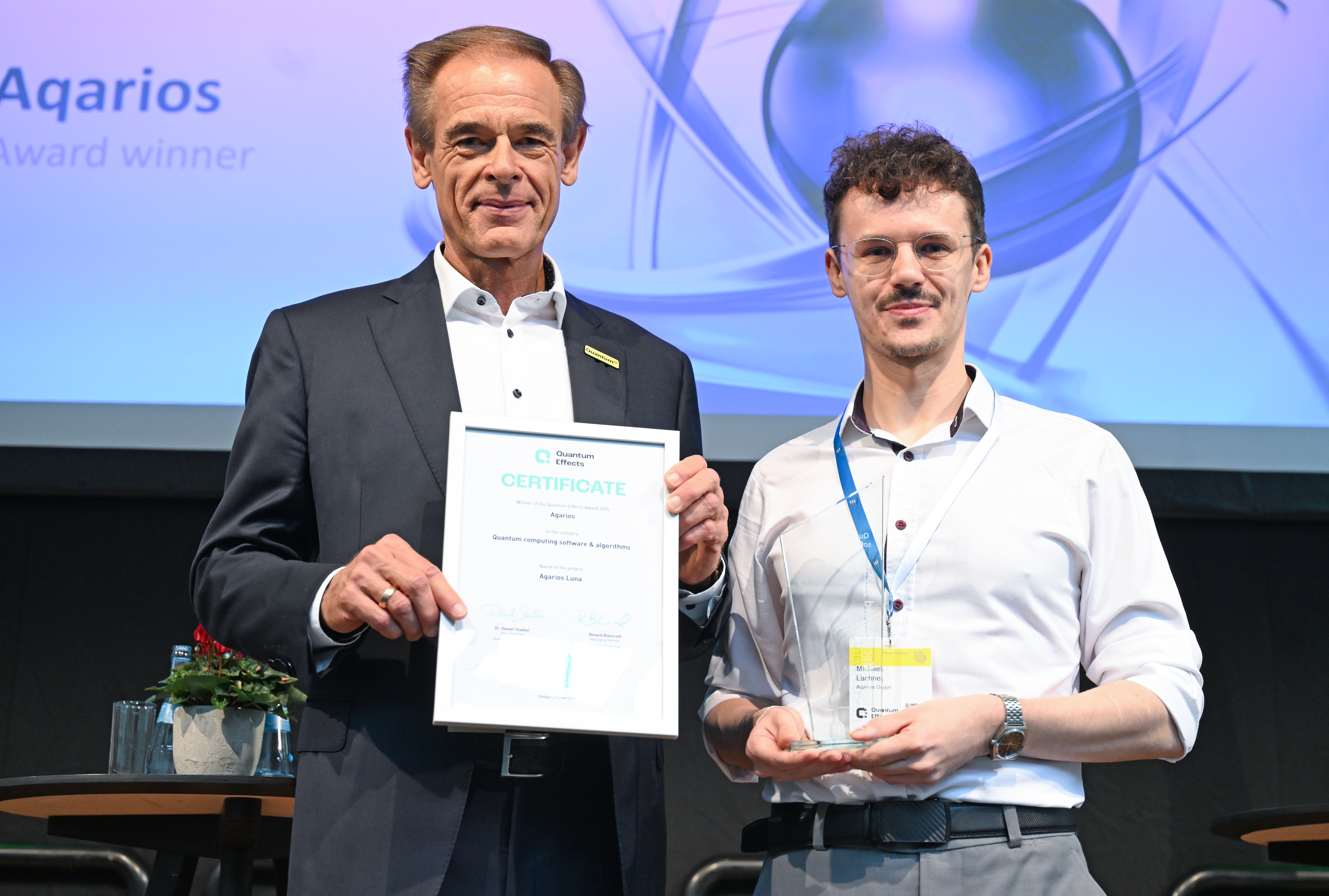
You won the Quantum Effects Award 2025 in the Quantum Computing Software & Algorithms category. What concrete impact has this award had on Aqarios since then – in terms of visibility, market buzz and the further development of your company?
The award has, in particular, given us credibility and visibility. When an independent jury from the worlds of science and industry recognises our work, it carries more weight than our own claims as a company. In practice, we’ve noticed that the award keeps coming up in conversations, often right at the start: “You won the Quantum Effects Award, didn’t you?” And internally, it has shown the team that the work of recent years is being noticed and recognised. That’s an important signal for the people who work on our solutions day in, day out.
With Aqarios Luna, you aim to tackle real-world optimisation problems in industry and business. What exactly does your solution do – explained simply for readers who aren’t yet familiar with quantum computing on a daily basis?
Optimisation problems arise everywhere in the economy: How do I efficiently allocate production orders to my machines? What is the best route for my fleet when delivering parcels? How do I distribute load across the power grid in such a way that costs are reduced whilst maintaining stability? Classical algorithms quickly reach their limits with these problems because complexity grows exponentially with the size of the problem. Quantum computing opens up new possibilities here for finding solutions that would be impossible to achieve using classical methods, or only with enormous effort.
Luna is a software platform that enables such problems to be solved using the best available methods. We combine access to classical, quantum-inspired and quantum-based solutions via a unified, hardware-agnostic interface. Users thus get the best of all worlds without having to delve into the technology themselves — no prior knowledge of quantum computing is required. We offer an end-to-end solution: all you need is an optimisation problem, and Luna allows you to tackle it directly using the best available solution method. On top of that, there is a whole suite of additional developer features: tools for benchmarking, automatic format translation for various backends, and much more.
Many people still associate quantum computing primarily with research and visions of the future. When did you personally first get the feeling that this wasn’t just technologically exciting, but could become a genuinely relevant product for the market?
For me personally, it was actually very early on, whilst I was still at university, when I first came into contact with quantum computing. Technologically, I was immediately fascinated. The idea that quantum mechanics could be used to tackle computational problems that are structurally beyond the capabilities of classical computers. But from the very beginning, I was even more preoccupied with the other question: how do you bridge the gap to practical application? How do you deploy it in a way that creates value for businesses?
Aqarios has repeatedly seen evidence that there is genuine commercial interest in this technology. We have worked on use cases with BASF, MTU, E.ON and many other companies, and have seen for ourselves that this interest is very real. Companies are actively seeking better solutions to their optimisation problems, and quantum computing is a powerful tool for achieving solutions that are unattainable using classical methods. When you put it all together — technology with real potential, companies with real needs, and hardly any platform connecting the two — it became clear to me: this is exactly why we are building Luna.
In your submission, you mentioned fields of application such as logistics, energy, finance and manufacturing. Why is optimisation in particular such an obvious and important area of application for quantum computing?
Because optimisation problems are among the most computationally intensive problems there are, and at the same time have direct economic relevance. A classic example is the so-called Travelling Salesman Problem: you are looking for the shortest route through a series of cities. You want to visit each city only once and end up back in the starting city. That sounds quite simple so far. But if you look at it mathematically, you come across the following: with just ten cities, there are already over 360,000 possible routes. With twenty cities, the figure rises to 122 quadrillion. With fifty, the number of possible routes exceeds the number of atoms in the observable universe. This is exponential growth and the reality of the complexity behind logistics planning, production control, network optimisation and much more.
These are problems that, at present, can only be tackled through massive simplifications or enormous computational effort. For businesses, this translates into wasted resources, excessive costs and untapped potential on a daily basis. Quantum computers, on the other hand, make it possible to address such problems more efficiently by arriving at solutions much more quickly, or by finding solutions that are simply unattainable using classical methods. And that is precisely where the greatest potential lies.
In your view, what makes Aqarios Luna stand out from other approaches – and why does the market need a platform like this?
Most approaches in the field of quantum computing are either heavily hardware-oriented or very academically focused. Luna is deliberately designed differently: it is technology-neutral and geared towards real-world industrial applications. Companies can use different quantum computers, as well as classical and quantum-inspired algorithms, via a unified platform without having to commit to a single technology. To this end, Luna offers a range of tools that make it possible to work with quantum computing without requiring in-depth expert knowledge. There is no need to hire hard-to-find and expensive quantum computing specialists to work with the technology. Luna handles the technical complexity.
On the algorithmic side, we have developed proprietary algorithms specifically tailored to quantum optimisation which, unlike many other approaches, are designed to tackle problems as they actually arise in the real world — with complex constraints, practical problem structures and genuine scaling requirements.
The result is a platform that enables users to leverage quantum optimisation and work in a familiar environment without having to build a huge and expensive QC team, but instead focusing on what matters: value-adding solutions.
You mention that Luna helps companies minimise the risks involved in hardware selection and integration and provides end-to-end solutions. In your view, how important is this very link between technology and business execution for quantum computing to become a reality?
Technology and algorithms are, of course, the basic prerequisites. Without powerful quantum algorithms and hardware, there is nothing to build on. But the reality is that an algorithm alone is of no use to a company at first. You need the knowledge of how to use this algorithm, for which applications it actually makes sense, and how to integrate the results into existing processes and systems so that real economic value is created.
It is precisely this bridge that is crucial for translating research and technological development into real-world business applications. In our projects, we have seen time and again that it is not just about the algorithm and computing power, but equally about this: how does the result get into the operational process? How do you ensure that a company can actually use the solution? Luna was built with this question in mind. Not as a tool for quantum experts, but as an end-to-end pipeline that covers the path from problem to usable solution.
Looking ahead to the coming months: where is Aqarios headed next – in terms of technology, business strategy and real-world applications?
We are already helping companies solve their optimisation problems using the best methods available, whilst also helping them understand where and how quantum computing can be usefully applied in their specific context. That remains our core focus. In parallel, we are continuing to work on the technology itself. Luna is being expanded, our own algorithms are being constantly improved and tested on new, real-world industrial use cases. The long-term goal is to establish Luna as the standard platform for optimisation using quantum computing.
What advice would you give to start-ups and companies considering applying for the Quantum Effects Award 2026 with their own innovation?
Be honest and be specific. The jury doesn’t judge who uses the most impressive buzzwords, but who brings real substance to the table. That means demonstrable results, a clear problem statement and a realistic assessment of the technology. Show a concrete use case with measurable results, even if it’s small. A realistic demo or concrete, demonstrable applications beat any PowerPoint vision.
zurück zur Übersicht